




- Home

- Learn
- Healthcare
- HIPAA-Compliant CRM for Healthcare Providers
HEALTHCARE
HIPAA-Compliant CRM for Healthcare Providers
Contents

 10 min read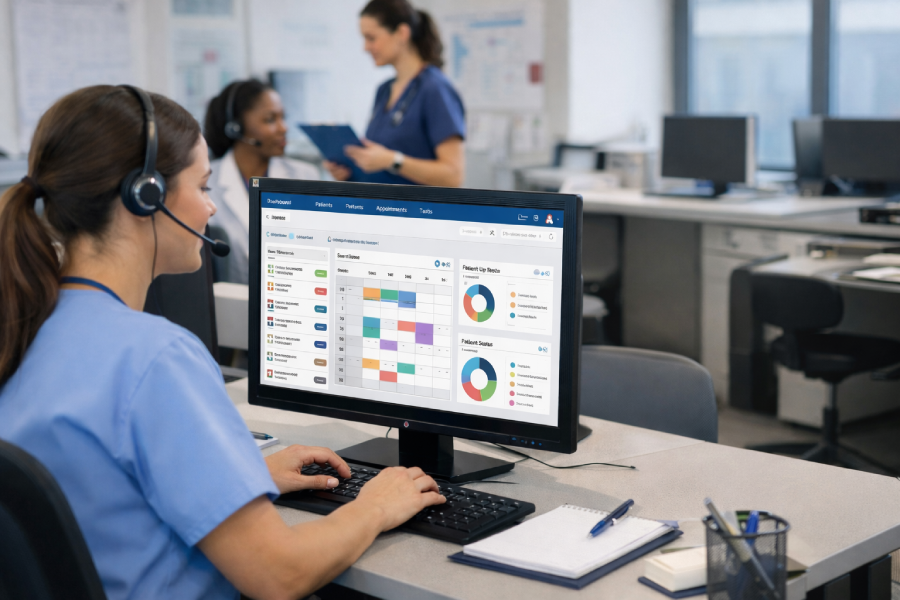


Healthcare teams need a system that keeps patient data secure while making intake, follow-ups, and communication easier to manage.
With LeadSquared’s HIPAA-compliant CRM, patient inquiries, scheduling, and engagement all sit in one platform, so teams no longer rely on disconnected tools.
Built for US healthcare providers, it helps reduce manual work, improve response time, and give full visibility into every patient interaction, while keeping sensitive data protected through strict HIPAA compliance software standards.
Without a centralized CRM in the hospital industry, teams often rely on a mix of spreadsheets, call logs, and disconnected systems. This makes it harder to manage patient flow, follow-ups, and communication, while also increasing the risk of compliance gaps.
Here are some of the common challenges healthcare teams deal with:
Managing patient intake, communication, and follow-ups does not need to be scattered or hard to track. With LeadSquared’s HIPAA-compliant CRM, healthcare teams can bring every step of the patient journey into one system and manage it with more clarity.
Instead of switching between tools, teams can capture patient inquiries, assign follow-ups, schedule appointments, and track progress in one place. This improves response speed, reduces delays, and keeps every interaction organized.
Because the platform is built for the hospital CRM needs of US providers, it supports real-world workflows like call center operations, field teams, and multi-location coordination. It also includes built-in controls that help teams handle sensitive data in line with HIPAA compliance software requirements, keeping operations efficient and secure.
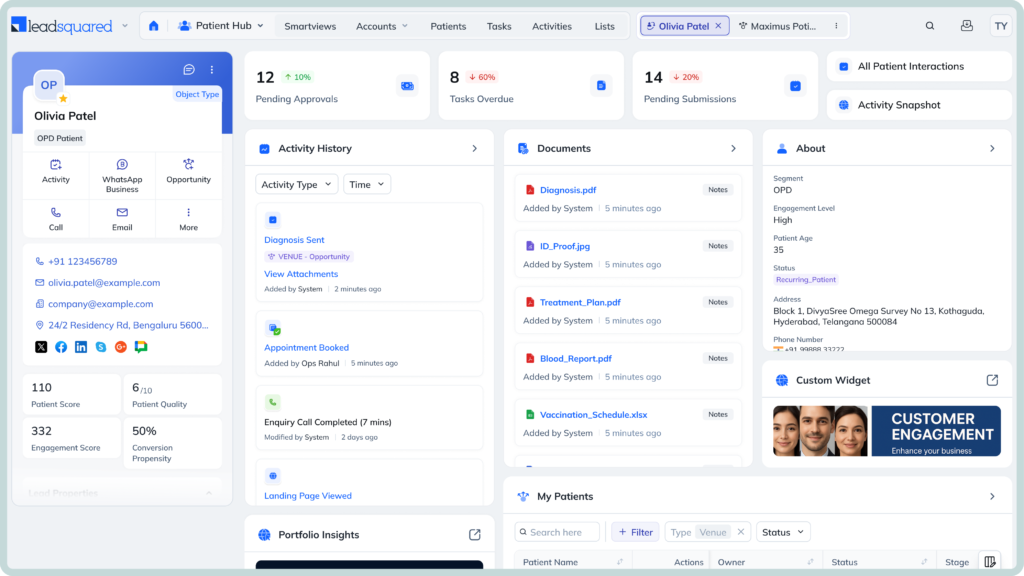
When patient workflows are managed in one system, teams can respond faster, reduce delays, and keep operations under control. Here’s what that looks like in practice:
To manage patient intake, communication, and follow-ups effectively, healthcare teams need a clear structure across each stage of the workflow.
The following capabilities show how the system supports daily operations while keeping processes organized and compliant.
Here are the core areas that support how teams manage patient flow, coordination, and communication across departments:
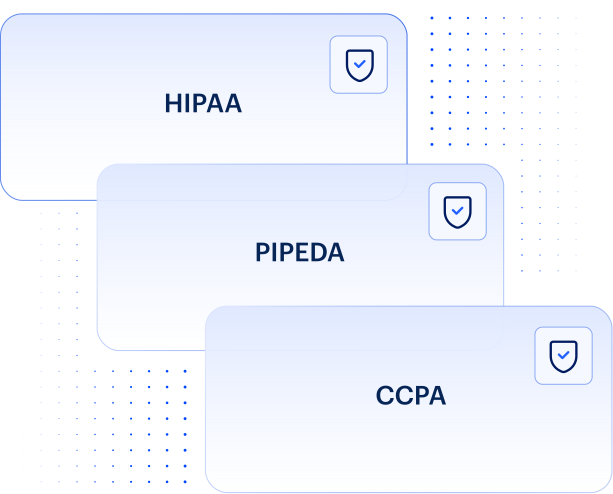
The following controls support secure access, tracking, and handling of patient data across every interaction:

The platform supports healthcare operations such as:
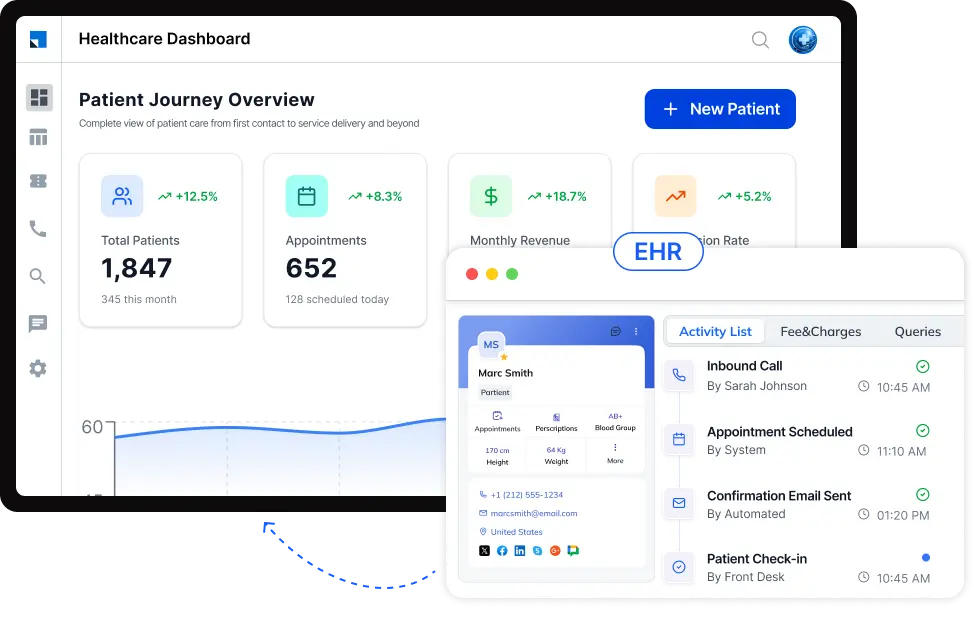
The following integrations help connect existing tools used across healthcare operations:
When evaluating a hospital CRM, healthcare teams often compare generic CRMs and legacy healthcare systems. The difference usually comes down to how well the system supports healthcare workflows, compliance, and day-to-day operations.
When evaluating a hospital CRM, healthcare teams often compare generic CRMs and legacy healthcare systems. The difference usually comes down to how well the system supports healthcare workflows, compliance, and day-to-day operations.
Here’s how LeadSquared stands out:
Managing patient intake, communication, and follow-ups becomes easier when everything is handled in one system. With LeadSquared’s HIPAA-compliant CRM, healthcare teams can reduce manual work, improve response times, and keep patient data secure.
If you’re looking for a hospital CRM that fits US healthcare workflows and supports HIPAA compliance software requirements, LeadSquared provides a solution for managing patient intake, communication, and follow-ups in one platform.
Book a demo to see how the platform can support your team.
Yes, LeadSquared offers a HIPAA-compliant healthcare CRM with a Business Associate Agreement (BAA) in place to help ensure your patient data stays protected.
If you’re a healthcare organization, handling sensitive patient information is part of your daily workflow. This means staying compliant with HIPAA (Health Insurance Portability and Accountability Act) is a must. LeadSquared’s CRM is built with that responsibility in mind.
Here’s how it helps you stay compliant while managing patient and lead data effectively:
Business Associate Agreement (BAA): A clear agreement that defines the HIPAA responsibilities between your practice and the third-party services we provide.
Data encryption: Protects information both when it’s stored and when it’s being transmitted.
Access controls: Ensures only authorized team members can view sensitive data.
Audit trails: Tracks every user action for accountability and transparency.
Secure storage: Keeps all PHI (Protected Health Information) safe from breaches or unauthorized access.
Implementation timelines depend on your setup and integrations. Most healthcare teams can get started within a few weeks, with support provided during onboarding.
It helps you stay organized, respond faster, and personalize communication. When patients get timely reminders, fast answers to their questions, and relevant follow-ups, they feel cared for. A CRM makes those touchpoints easy to manage—without relying on memory or manual tracking.
Yes. The system supports multi-location operations, allowing teams to manage patient workflows, communication, and performance across different sites in one place.
LeadSquared healthcare CRM is built keeping the industry-wide use cases in mind. It covers the functionalities required by healthcare institutions. But yes, the platform is customizable to fit unique workflows and business requirements of your healthcare practice.
Yes, the LeadSquared platform allows users to migrate patient data from other CRMs safely and securely.
Most HIPAA-compliant healthcare CRMs today are built to be user-friendly, but yes, a bit of onboarding goes a long way. With LeadSquared, for instance, the interface is intuitive, and there’s plenty of support available—live training, help guides, and a support team to get your staff up and running quickly.
Yes, LeadSquared offers specialized CRM platforms for different healthcare verticals like hospice & palliative care, medical diagnosis centers, home care, online medical clinics, behavioral health clinics, and more.
You can automate a lot, including:
New patient follow-ups
Appointment confirmations and reminders
Missed appointment re-engagement
Feedback surveys after visits
Insurance status updates
Lead nurturing for health checkup packages, elective surgeries, etc.
This takes repetitive work off your team’s plate and ensures no patient slips through the cracks.
Medical institutions need a CRM to manage patient inquiries, route them to the right departments, book and manage appointments, automate intake and more importantly, manage interactions with patients.
Yes, LeadSquared provides ready integrations with several EHR systems like Epic, Homecare Homebase, AthenaHealth, DrChrono, eClinicalWorks, and more. It also offers custom integrations with other EHR tools of your choice. These integrations help ensure patient data flows smoothly between systems, reducing manual work and keeping everyone on the same page without compromising security.
Yes, LeadSquared offers specialized CRM platform for Hospice & Palliative care, medical diagnosis centres, homehealth care, online medical clinics, behavioral and mental health providers, and more.
Yes, LeadSquared web platform and mobile app are available in multiple languages like Vietnamese, Portuguese (Brazilian), Bahasa (Indonesia), Spanish (Latin America), and Hindi (India). Apart from the above, LeadSquared mobile CRM is available in multiple Indian languages like Tamil and Gujarati as well.
LeadSquared is a completely cloud-based SaaS CRM software.
LeadSquared integrates with many social media platforms for lead capture and retargeting. For instance, Facebook Lead Ads, Facebook Retargeting, and more.
Before implementing a CRM, you should define everything – the end goal or the purpose for your organization, what departments or teams would be using it, the features you need, and support for integration with other care tools you use.
Enter your details and we'll send you a quick confirmation email to verify your address.
 19 min read 17 min read 15 min read



 Mongoose Cadence starts the conversation. A CRM finishes it.
